
kalabhumitalkies.com

October 2026

Introducing MOMENTUM 5 Series in India: Your Sound Revelation Starts Here

The Sennheiser brand in India today announces the launch of MOMENTUM 5 Wireless headphones and the MOMENTUM True Wireless 5, the most capable and user-focused evolution of the acclaimed audio lineup yet. The newest MOMENTUM series preserves the category-defining sound and battery performance of the platinum-selling line while introducing meaningful enhancements to elevate everyday listening for the modern audio enthusiast.   Introducing MOMENTUM 5 Series in India: Your Sound Revelation Starts Here   MOMENTUM 5 Wireless: The True Sound Revelation The Sennheiser brand’s newest portable powerhouse is an escape into high-fidelity sound, enriched with spatial audio and a suite of sophisticated capabilities. Sennheiser’s category-defining over-ear headphone is powered by HD 600-inspired 42mm drivers, delivering pure audiophile detail with Dolby Atmos spatial tracking and Lossless codec support.   “With MOMENTUM 5 Wireless, we focused on refining the entire experience without straying from the formula that made its predecessor such a success.” Said Mr. Saahil Kumar, Country Head, Sennheiser (Consumer), India. “These enhancements enrich the overall functionality while still capturing the magic you feel every time you press play.”    Key Highlights – MOMENTUM 5 Wireless: HD 600-inspired 42mm drivers with Dolby Atmos spatial tracking and Lossless codec support 8-microphone hybrid ANC system, up to 3x stronger midrange noise suppression over MOMENTUM 4 Ongoing firmware updates to DSP and wireless engines for continually improving performance Unmatched 57-hour battery life with fast charging User-replaceable batteries and ear pads, eliminating product obsolescence Carrying case redesigned to be 20% flatter, with 16% less overall packaging Available in Black and Denim, with White, Bronze and Lavender coming soon   MOMENTUM True Wireless 5: Flagship Performance, Compact Form MOMENTUM True Wireless 5 brings uncompromised audiophile sound into a compact earbud profile, with TrueResponse transducers delivering 24-bit/96kHz high-res audio and Dolby Atmos 3D sound. A Hybrid Adaptive ANC system dynamically counters both ambient noise and wind, while Natural Transparency keeps listeners connected to their surroundings when needed.   Speaking about the MOMENTUM True Wireless 5, he further said, “We set out to bring the larger-than-life sound and connected technology of the MOMENTUM series into a remarkably compact format. From its exquisite audio reproduction to the advanced hardware powering, it all, MOMENTUM True Wireless 5 represents our most advanced integration of audio technology in an earbud.”   Key Highlights — MOMENTUM True Wireless 5: All-new design – Improved comfort, stability, and portability User-replaceable batteries – Easily refresh your run-time even years from now Optimized for Dolby Atmos® – Head-tracking unlocks immersive entertainment Improved voice calls & ANC – Voice accelerometer, expanded mic array, and AI speech enhancement Bluetooth® 6.0 – Prioritizes fast and stable connections Smart Control Plus – a new 8-band EQ highlights an assortment of customizable features in the free app Available in Graphite, Cream, Copper, Denim and Lavender   Signature Performance MOMENTUM 5 Wireless carries forward the acclaimed 42mm transducer from its predecessor, meticulously manufactured at Sennheiser’s state-of-the-art facility in Tullamore, Ireland, and inspired by the famed HD 600-series headphones for full-bodied sound with dynamic bass. It further advances its sonic capabilities with Hi-Res Audio certification and Snapdragon Sound™ technology with support for aptX™ Lossless. The MOMENTUM True Wireless 5 brings the same sound-first DNA to an in-ear form factor with Sennheiser’s signature 7mm TrueResponse dynamic transducer, also developed and manufactured in Tullamore, Ireland, alongside Bluetooth 6.0 with aptX Adaptive and aptX Lossless support for high-resolution audio up to 24-bit/96 kHz.   Total Immersion The newest MOMENTUM models pair rich sound with advanced noise cancellation and immersive spatial audio. MOMENTUM 5 Wireless features supercharged ANC that is up to three times more effective at reducing distracting voice chatter, with four microphones per side improving noise reduction and call quality. MOMENTUM True Wireless 5 features adaptive hybrid ANC, automatic anti-wind mode and a four-microphone array, while its eight-sensor system with AI-powered speech extraction enhances voice clarity in noisy environments. Both models are optimized for Dolby Atmos® with interactive head-tracking for an immersive, theater-like listening experience.   Refreshingly Responsible MOMENTUM 5 Wireless delivers up to 57 hours of battery life with ANC engaged and introduces a user-replaceable 700 mAh battery, allowing owners to refresh the power cell in minutes using only a small Phillips-head screwdriver, helping extend the headphones’ usable life without impacting acoustic performance. MOMENTUM True Wireless 5 extends the same longevity-focused approach with user-replaceable batteries in both the earbuds and charging case, offering up to 12 hours of playback per charge and up to 40 hours with the case. Both models also support quick charging, while MOMENTUM 5 Wireless features a 20% flatter carrying case and plastic-free packaging.   Ergonomic Evolution MOMENTUM True Wireless 5 features a redesigned, aerodynamic and fin-free housing developed using data from thousands of unique ear models, with 73% of testers rating it more comfortable than the previous generation. The earbuds are also IP54-rated for dust, sweat and splash resistance, while the micro-perforated acoustic mic plate helps reduce wind interference. Its redesigned charging case offers a narrower, pocket-friendly profile, while MOMENTUM 5 Wireless includes both USB-C and 3.5mm audio cables for added everyday versatility.   “Balancing our signature high-fidelity acoustics, advanced performance, and long-term usability is at the heart of the new MOMENTUM experience. With MOMENTUM 5 Wireless, our user-swappable battery, adaptable hardware, and compact, plastic-free packaging demonstrate that high-performance sound and environmental responsibility can, and must, exist in the same product. With MOMENTUM True Wireless 5, we are bringing flagship performance to a compact form factor while introducing a replaceable battery designed to extend the life of the product. Across both products, we are proving that cutting-edge audio does not have to come at the expense of longevity, giving listeners products they can enjoy for years to come,” concluded Mr. Saahil Kumar, Country Head, Sennheiser (Consumer), India.   Pricing, Offers and Availability MOMENTUM 5 Wireless will be available in India at a launch price of INR 39,990, while MOMENTUM True Wireless 5 will be available at INR 29,990. Pre-orders for both products begin on September 24, 2026, across Sennheiser’s official

Introducing MOMENTUM 5 Series in India: Your Sound Revelation Starts Here Read More »
Manipal University Jaipur Organises Four-Day Faculty Development Programme in Collaboration with IIMBx, IIM Bangalore

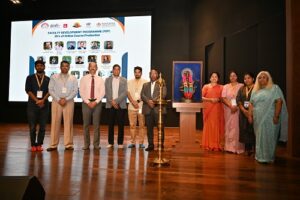
The Centre for Distance and Online Education (CDOE), Manipal University Jaipur, is organising a four-day Faculty Development Programme (FDP) in collaboration with IIMBx, the digital learning foundation of the Indian Institute of Management Bangalore (IIM Bangalore). Based on the theme “3D’s: Design, Develop, Deliver, the programme aims to familiarise faculty members with the complete process of designing and developing online and digital courses. The programme provides hands-on training in course design, digital learning content development, the use of Artificial Intelligence (AI), studio-based educational video production, learning activity design, assessment development, and preparing courses for delivery through online platforms. The four-day programme covers the complete journey from course design and content development to AI-enabled activities, studio recording, assessment and course presentation.    Dignitaries present in the Inaugural session of the FDP at Manipal University Jaipur   The programme was formally inaugurated in the presence of Pro-President Cdr. (Dr.) Anil Rana; Director CDOE, Dr. Mallikarjun Gaddapa; Dean Faculty of Management, Commerce and Arts (FoMCA) Dr. Brijesh; and senior representatives and experts from IIMBx, including Shainesh G., Chairperson, IIMBx; Sitaraman Shankar; Dr. S. Naga Siddharth; and Vijaya Tripathi, along with the IIMBx and SWAYAM expert and technical teams. The programme is being supported by experts including Shweta Shree, Raksha B., Manikandan K., Erwin Fernandes, Diljith Kannan, Nidhi A.C., Vishal C. Reddy, Sushma Nayak, Varun P., Bhumika Arora, Kalaiarasan R., Megha Srinivasan, Rajamohamadu Jeeyavudeen, Aarya S. Kumar, Malhar Patel and Anjali Alex, who are contributing to various sessions related to course design, content development, technology, video production, instructional design and SWAYAM course development.    The four-day programme is structured around three key stages Design, Develop and Deliver. On the first day, faculty members are being trained to understand the needs of online learners, develop learner profiles, and align learning outcomes, course content and assessment. Participants are also being provided with hands-on experience in developing a module outline for their respective subjects and creating video scripts based on their course design. The second day focuses on the Develop stage, with particular emphasis on Artificial Intelligence and digital content production. Participants are being introduced to the fundamentals of Generative AI, its applications, strengths, limitations and associated risks. The programme also includes training in active learning activities and studio-based educational video production. Faculty members are getting an opportunity to record their learning videos and receive immediate expert feedback on delivery, pacing and the effective use of teaching aids. The third day focuses on the Deliver stage and will address the changing landscape of online education, the use of AI as a teaching and course-design assistant, and assessment development. Participants will be trained in developing different forms of assessments and aligning them with learning outcomes, as well as using AI for developing question banks with appropriate faculty validation. The programme will also include a showcase and peer review of participant-developed educational videos, followed by an orientation on course development, approval and launch through the SWAYAM platform. On the final day, participants will present their course blueprints in groups before an expert panel comprising members from IIMBx and Manipal University Jaipur. Each group will present its learner profile, course or module outline, sample script or video, learning activity, assessment and course launch plan. The presentations will be followed by expert and peer feedback and interaction with the panel. The programme will conclude with closing remarks and certificate distribution by Sitaraman Shankar, CEO, IIMBX.    Dr. Mallikarjun Gaddapa, Director, CDOE, said, “Higher education is rapidly becoming more digital and learner centric. In this environment, subject expertise alone is not sufficient for faculty members; they also need capabilities in online course design, digital learning content development, AI-enabled teaching and outcome-based assessment. The FDP being organised in collaboration with IIMBx is providing faculty members with comprehensive hands-on exposure, from developing the initial course outline to digital content production, studio recording, assessment and online delivery. Our objective is to develop high-quality courses that respond effectively to the needs of contemporary learners.”   Shainesh G., Chairperson, IIMBx said, the objective of this programme is not merely to train faculty members, but to provide them with practical experience of the complete online course development process. From identifying learners and developing the course framework to scriptwriting, AI-enabled content development, studio recording, learning activities, assessment and preparing the course for online delivery, participants are getting an opportunity to work through every stage of the process. The collaboration between IIMBx and Manipal University Jaipur provides a strong platform for faculty members to experiment, receive expert feedback and develop modern, technology-enabled, learner-centric and outcome-oriented courses. The programme is designed as a hands-on and outcome-oriented faculty development initiative, enabling participants to move beyond theoretical understanding and work on tangible course-development outputs. The initiative is aimed at further strengthening the quality of digital and online education at Manipal University Jaipur and equipping faculty members with the capabilities required for contemporary teaching and learning. The collaboration brings together the digital learning expertise of IIMBx and the academic ecosystem of Manipal University Jaipur, providing faculty members with an effective platform to develop innovative, technology-enabled, learner-centric and outcome-based courses.

Manipal University Jaipur Organises Four-Day Faculty Development Programme in Collaboration with IIMBx, IIM Bangalore Read More »

Raj Subramaniam, President and Chief Executive Officer of FedEx Corporation, Receives Appeal of Conscience Award

The Appeal of Conscience Foundation presented Raj Subramaniam, president and chief executive officer of FedEx Corporation, with the Appeal of Conscience Award at the foundation’s 61st Annual Gala, at The Pierre Hotel in New York City.   Raj Subramaniam, President & CEO FedEx Corporation with Karen Schneier Dresbach, Executive Vice President, & Rabbi Arthur Schneier, Founder & President, Appeal of Conscience Foundation   As president and CEO of FedEx Corporation, Subramaniam leads one of the world’s largest transportation and logistics companies. A more than 35-year FedEx veteran, Subramaniam became the second CEO in the company’s history in 2022 after serving in a series of leadership roles across the global enterprise, including as President and Chief Operating Officer. His international leadership experience and focus on globalization have contributed to the success and transformation of FedEx, while his work outside the company has focused on advancing economic growth and global trade. In 2023, Subramaniam received the Pravasi Bharatiya Samman Award, the highest civilian honor presented by the President of India to members of the Indian diaspora in recognition of outstanding achievements in India and abroad.   “I am honored to receive the Appeal of Conscience Award from Rabbi Schneier and the Appeal of Conscience Foundation,” said Raj Subramaniam, president and CEO of FedEx. “At FedEx, we believe that connecting the world through trade and innovation does more than move goods – it builds bridges, fosters international cooperation, and brings communities closer together. We are committed to leveraging our global reach to build a more connected and unified world.”   Through its global network, FedEx connects businesses and economies, enabling trade and creating pathways for businesses to reach markets around the world. In India, FedEx continues to strengthen its infrastructure and capabilities, supporting Indian businesses in accessing international markets and participating in global trade.   “Raj Subramaniam is being recognized for his international visionary leadership and steadfast commitment to connecting people worldwide through innovation and service,” said Rabbi Arthur Schneier, founder and president of the Appeal of Conscience Foundation. “Under his stewardship, FedEx has advanced a culture of social and global responsibility and international cooperation that reflects ACF’s mission.”   Previous Honorees The ACF has recognized prominent business leaders and public figures with the Appeal of Conscience Award including: Bernard Arnault, Mary Barra, Barbara Bush, Michael Bloomberg, Albert Bourla, Archbishop Elpidophoros, Robert Iger, Muhtar Kent, Coretta Scott King, Robert Kraft, Brian Moynihan, Virginia Rometty, Stephen A. Schwarzman, Masayoshi Son, Paul Volcker, Timotheus Höttges, Stephen M. Ross, Susan Wojcicki, Dr. Rong Yiren, Dr. Henry Kissinger, Cardinal Timothy Dolan and Tony Elumelu.

Raj Subramaniam, President and Chief Executive Officer of FedEx Corporation, Receives Appeal of Conscience Award Read More »

IFQM Symposium 2026: India's Journey Towards Viksit Bharat Must be Powered by Quality, Innovation and Scale

India’s ambition to become a globally competitive, self-reliant and innovation-led economy must be underpinned by a strong culture of quality, innovation and excellence, emerged as a key message on Day 1 of the third edition of the IFQM Symposium 2026 in New Delhi. Bringing together senior industry leaders, policymakers, global quality experts, CEOs, CXOs and academia, the symposium explored how India can leverage its scale, technology and human capital to build globally competitive institutions and enterprises.   Shri Jyotiraditya M. Scindia, Union Minister for Communications & Development of North-Eastern Region, Government of India with GC members of IFQM Delivering the keynote address on “Powering Viksit Bharat – Scale without Boundaries to Advance Development through Technology, Digital Innovation and Inclusive Connectivity,” Shri Jyotiraditya M. Scindia – Union Minister for Communications and Development of North Eastern Region, Government of India said that the world will soon look to India to learn about quality, innovation and self-reliance. He highlighted the role of initiatives such as IFQM in taking India forward towards Viksit Bharat@2047 and strengthening the country’s journey towards Atmanirbharta. IFQM, established by a consortium of India’s leading enterprises, is an industry-led movement committed to catalysing Indian organisations to become globally competitive and export-capable through Quality, Innovation and Excellence. The Foundation is focused on strengthening the capabilities of Indian industry, including MSMEs, through initiatives that promote quality, innovation and sustainable development in line with the nation-first objectives of Viksit Bharat. Speaking at the symposium, Mr. N. Chandrasekaran, Executive Chairman, Tata Sons, highlighted India’s progress in building sustainable, world-class infrastructure and institutions. He said, “India has made tremendous progress in developing sustainable world-class infrastructure and institutions. Our economy is doing very well, and over the last few years it has exceeded expectations. Achieving this amid global economic uncertainty is no mean task. It was possible because of infrastructure growth, manufacturing, especially precision manufacturing and investment in human process (education and skill development).” Delivering the inaugural address, Mr. S.N. Subrahmanyan, Chairman & Managing Director, Larsen & Toubro, focused on the importance of making quality a culture across organisations. He said, “In infrastructure, doing projects with quality is critical. We are still not there yet; there is a lot to learn from global practices. Hopefully, initiatives like IFQM will help us reach that level of excellence. Personally, I can share many examples, and each one contributes to the lessons we need to achieve quality. Every employee has to be involved. It’s not just about quality; it’s about innovation. Quality has to be a culture; I think that will make it happen.” Recognising Excellence in Quality and Governance A key highlight of Day 1 was the recognition of Mr. Venu Srinivasan, Chairman, IFQM, by the International Academy for Quality (IAQ) with the Marcos E. J. Bertin Quality in Governance Medal, recognising his contribution to advancing sound governance through quality principles and methods. The honour was presented by Mr. Sunil Sinha, Trustee, IAQ, and Mr. Raúl Molteni, President, IAQ. Speaking on the occasion, Mr. Raul Molteni, President – International Academy for Quality highlighted IAQ’s vision of moving beyond traditional quality management towards “quality for humanity”, and underscored India’s growing importance in advancing this agenda. He noted that Indian companies have demonstrated that Total Quality Management (TQM) can be implemented at scale and evolve into a broader movement. Mr. Sinha emphasised the importance of recognising leaders who have embedded quality into the way organisations are managed and governed. Reflecting on TVS Motor Company’s quality journey, Mr. Venu Srinivasan recalled how Japanese quality experts helped strengthen the company’s focus on TQM more than three decades ago. He emphasised that the Deming Prize should not be viewed as the destination, but as the beginning of an organisation’s TQM journey. He noted that the journey extends beyond processes and practices to building trust with stakeholders, highlighting the responsibility that comes with good governance. IFQM and karlsruhe institute of technology (kit) join hands to strengthen industry–academia collaboration Further strengthening its focus on knowledge, research and capability building, IFQM and the Karlsruhe Institute of Technology (KIT) formalised a new collaboration through a Memorandum of Understanding (MoU) at the symposium. Mr. Soumitra Bhattacharya, CEO and Director, IFQM, exchanged the MoU with Prof. Dr.-Ing. Gisela Lanza, Karlsruhe Institute of Technology, in the presence of Mr. Venu Srinivasan, Chairman Emeritus, TVS Motor Company. The collaboration will strengthen cooperation in quality and innovation and reflects a shared ambition to embed these principles more deeply into the systems and processes that drive industry. The partnership will also advance IFQM’s focus on industry–academia collaboration, connecting academic research and expertise with the evolving needs of Indian industry. Taking the quality conversation across sectors Day 1 featured six panel discussions that brought together industry leaders and MSMEs to examine the challenges and opportunities across sectors and demonstrate how quality and innovation can create measurable impact. The discussions included “Pharma & Life Sciences: Moving Beyond Generics – Pioneering Global Leadership in Innovative Medicine”; “From Scale to Excellence: Reimagining Infrastructure for India’s Global Leadership”; “IFQM as Force Multiplier – Measurable Impact Across Sectors”; “Humble Beginnings to Global Standards – The Force Multiplier Playbook”; and “Transforming India into a Trusted Global Electronics Hub.” The sessions also highlighted the experiences of MSMEs that have benefited from the IFQM initiative, showcasing how focused interventions in quality, technology, capability building and innovation can help businesses strengthen their competitiveness and move towards global standards. Day 1 also featured five keynote addresses exploring India’s Viksit Bharat ambition, quality and innovation, technology-led transformation, artificial intelligence and global competitiveness, including perspectives on China’s evolving role in the global economy. An exclusive CEO session, “Creating Force Multipliers for the Industry-led Movement – Boardroom Vision to Shop Floor Excellence,” brought together senior business leaders to examine the practices and organisational interventions that can translate boardroom vision into excellence on the shop floor. The session focused on how leadership commitment, employee participation, quality culture and innovation can work together to create sustainable and measurable impact across organisations. With its first day bringing together perspectives

IFQM Symposium 2026: India's Journey Towards Viksit Bharat Must be Powered by Quality, Innovation and Scale Read More »

How the VinFast VF 6 Fits the "Family 4.0" Lifestyle

When the family already runs on smartphones, apps and connected devices, the VinFast VF 6 brings the same thinking to the driveway, with smart features and ownership benefits designed around everyday life.   The VinFast VF 6 brings smart, connected mobility to the modern family, combining intuitive technology, advanced safety features and practical ownership benefits for everyday life The family car has entered its digital era There was a time when choosing a family car meant counting seats, checking the boot and asking whether the air-conditioning could survive an Indian summer. Those things still matter today, of course, but modern families can also ask another question: how smart is the car when everyone else in the household is already connected? That is where the “Family 4.0” idea comes in. This is a generation that manages school schedules on phones, orders groceries through apps and controls half the home from a screen. It makes sense, then, that the family car should join the conversation. The VinFast VF 6 does exactly that At the centre of the cabin is a 12.9-inch driver-oriented infotainment screen, putting vehicle functions and entertainment within easy reach. Wireless Android Auto and Apple CarPlay are also available, while features such as Pet, Camp, Wash and Valet modes are designed for some of the less glamorous realities of everyday ownership. Then there is the part that feels particularly 4.0: the driver does not have to be sitting inside the car to interact with it. Through the VinFast smartphone app, owners can remotely control selected functions such as the doors, boot, windows, climate control and special modes, check vehicle status and location, and receive notifications for selected events. So the car can be checked or adjusted from a phone before the family even heads out, rather than requiring someone to make a trip downstairs just to see whether everything is ready. The VF 6 can also receive over-the-air software updates, allowing compatible software and connected functions to be updated without turning every update into a workshop visit. And when the school run turns into the school run plus five other errands, there is some help from the car itself. Depending on the variant, the India-spec VF 6 offers up to 14 ADAS features, along with seven airbags and a 360-degree surround-view monitoring system. Higher variants can include functions such as adaptive cruise control, lane-centering control, automatic emergency braking, blind-spot detection and rear cross-traffic alert. In short, the VF 6 is not asking the family to leave its digital lifestyle at the front door. It is designed to bring some of that connected convenience along for the ride. A little less spending, a little more living Still, no amount of clever technology can make a family ignore the household budget. The monthly running cost still has a habit of getting everyone’s attention. That is another area where the VF 6 makes a compelling case for going electric.  The VF 6 uses a 59.6-kWh usable battery and offers up to 468 km of MIDC range, depending on the variant. The higher-output version delivers up to 150 kW (204 PS) and 310 Nm, while DC fast charging can take the battery from 10% to 70% in around 25 minutes under specified conditions.   The potential savings can add up over time. According to VinFast’s web-based Total Cost of Ownership tool, which calculates the savings of its EV models, the VF 6 Wind can deliver total savings of INR 4.4 lakh over three years compared with a common ICE vehicle at 1,500 km of monthly driving, equivalent to 19% lower total cost of ownership. Its estimated monthly energy cost is also just INR 1,544, compared with INR 9,281 for the ICE comparison. VinFast has also put practical support behind the transition to electric. Free charging at V-Green stations is available through March 31, 2029, under the applicable programme, potentially reducing charging costs further during the eligible period. There is also free maintenance for up to 3 years or 36,000 km, whichever comes first, helping make scheduled ownership costs more predictable. And under its ICE-to-EV programme, VF 6 buyers can receive up to INR 154,000 in cash support, depending on the variant and eligibility. The VF 6 is also backed by up to a 7-year/160,000-km vehicle warranty and up to a 10-year/200,000-km battery warranty, depending on the applicable model and terms, adding another layer of predictability to long-term ownership. The car that gets the family group chat Ultimately, the “Family 4.0” appeal of the VF 6 comes down to how naturally it fits into the routines of a connected household. The phone can interact with the car. The car can update itself. The driver can access selected functions remotely. Safety systems can provide additional assistance on the road. And ownership policies can help take some of the sting out of charging, maintenance and the switch from an ICE vehicle. That combination gives the VF 6 a distinctly modern take on the family car. It is not simply a vehicle that fits into the family’s daily routine, but one designed to work alongside the connected lifestyle that shapes it. About VinFast VinFast (NASDAQ: VFS), a subsidiary of Vingroup JSC, one of Vietnam’s largest conglomerates, is a pure-play electric vehicle (“EV”) manufacturer with the mission of making EVs accessible to everyone. VinFast’s product lineup today includes a wide range of electric SUVs, e-scooters, and e-buses.  VinFast is currently embarking on its next growth phase through rapid expansion of its distribution and dealership network globally and increasing its manufacturing capacities with a focus on key markets across North America, Europe, the Middle East and Asia. Learn more at: vinfastauto.in

How the VinFast VF 6 Fits the "Family 4.0" Lifestyle Read More »

Bitcoin and Ethereum: Five Key Steps for Investors to Navigate the Next Phase

Bitcoin and Ethereum have entered October with a broadly stable market structure, but neither has confirmed a decisive breakout. Bitcoin traded between approximately USD83,020 and USD83,775 during the period before settling near USD83,461. Ethereum performed slightly better, rising from around USD2,658 to USD2,689.   The market is not displaying widespread fear, but investors remain selective because interest rates and US Treasury yields are still elevated. Here is a five-step guide to understanding what may happen next.   Watching whether global liquidity improves The wider macroeconomic environment provides an important backdrop to recent crypto-market movements. Softer US inflation, weaker job openings and lower consumer confidence have reduced expectations of an immediate Federal Reserve rate increase, while China’s manufacturing PMI has returned to expansion, pointing to an improvement in economic activity.   Market analysts generally associate easing rate expectations with better liquidity conditions for risk-sensitive assets, including Bitcoin and Ethereum. However, the US 10-year Treasury yield remains above 5.3%, keeping financial conditions restrictive and increasing competition from interest-bearing assets.   Analysts therefore see the direction of inflation, Treasury yields and central-bank policy as important influences on the market’s next phase. Further moderation in inflation and yields could improve the liquidity backdrop, while persistently elevated yields may keep Bitcoin and Ethereum within their recent trading ranges despite relatively constructive technical structures.   Bitcoin must hold support before attempting a breakout Bitcoin is trading around USD83,000, still considerably below its October 2025 high of over USD126,000, but significantly above the levels near USD60,000 seen earlier this year. Over the past six months, Bitcoin has moved through a wide range rather than following a straight upward path.    After trading around 78,000-80,000 in April and early May, it fell toward USD64,000 in July before recovering above USD80,000 in August. Bitcoin was trading near USD83,461 at the beginning of October, representing a gain of approximately 30% from its July level and around 7% from late April.    Bitcoin’s immediate support is around 83,300-83,400. This is the first area where buyers need to remain active. If this level does not hold, the next support areas are approximately 82,000-82,100 and 81,100-81,600.   A decline toward these levels would not automatically end the broader positive structure. It would, however, show that buyers are losing short-term control. A sustained break below USD81,100 would make the near-term outlook more cautious. On the upside, Bitcoin faces resistance around 84,200-84,600. Moving briefly above this range would not be sufficient. A convincing breakout would require the price to remain above resistance, accompanied by stronger trading volume and continued participation from spot buyers.   The next Bitcoin move therefore has two clear possibilities: holding above USD83,300 could lead to another attempt at USD84,600, while losing support could extend the consolidation toward USD82,000 or lower.   Ethereum needs to establish itself above USD2,700 Ethereum has experienced an uneven but meaningful recovery over the past six months. After trading around 2,300-2,370 in April, it fell toward USD1,770 in early June and remained below USD1,900 during parts of August. The asset subsequently recovered above USD2,300 and moved into the 2,450-2,550 range in early September. At approximately USD2,689 on October 1, Ethereum was around 14-15% above its mid-April level and nearly 52% above its June low.    Ethereum advanced by approximately 1.2% during the period, outperforming Bitcoin slightly. However, it continues to trade around the psychologically important USD2,700 level.   Immediate support lies at approximately 2,670-2,680. If that zone holds, Ethereum could make another attempt to move above the 2,695-2,720 resistance area. A sustained move above USD2,720 would improve the probability of further recovery. If Ethereum is rejected again, attention may shift toward 2,620-2,630, followed by the broader USD2,600 support area. The repeated tests of USD2,700 show that buyers remain interested, but they have not yet demonstrated enough strength to establish a clear breakout.   Investors trading Ethereum Futures should be particularly cautious. Leverage can magnify losses, and a temporary move above resistance can quickly reverse if it is not supported by volume and genuine spot-market demand.   ETF flows will indicate whether institutions remain committed Crypto exchange-traded funds recorded approximately USD1.9 billion in overall net inflows during the period, even after an outflow of around USD200 million on September 30. Ethereum ETFs recorded an estimated USD34.9 million in net inflows.   These figures indicate that institutional interest remains present, but ETF buying does not guarantee an immediate increase in price. New demand can be absorbed by profit-taking, exchange selling, derivatives positioning or investors reducing exposure elsewhere.   The more important signal is consistency. Several sessions of broad ETF inflows would strengthen the case for a Bitcoin and Ethereum breakout. Repeated outflows, particularly alongside falling prices, would suggest that institutional demand is weakening.   Preparing for scenarios instead of predicting one outcome Analysts identify two broad possibilities for the market’s next phase. In a constructive scenario, Bitcoin would maintain support above USD83,300 and move beyond USD84,600, while Ethereum would hold above USD2,670 and establish itself beyond USD2,720. Stronger ETF flows and declining Treasury yields would provide a more supportive backdrop for such a move.   A neutral scenario would involve continued sideways trading, with Bitcoin remaining between approximately USD82,000 and USD84,600 and Ethereum moving between USD2,620 and USD2,720. Analysts view this type of consolidation as a period in which the market absorbs recent gains without confirming either a sustained rally or a deeper correction.   Support and resistance levels provide useful reference points for assessing these scenarios, but they do not predict outcomes. Analysts are therefore watching whether price action, trading volume, ETF demand and the wider macroeconomic environment begin moving in the same direction before interpreting the next move in Bitcoin and Ethereum as a broader trend.

Bitcoin and Ethereum: Five Key Steps for Investors to Navigate the Next Phase Read More »

Smile Train India Brings Smile Walls to Communities Across the Country for World Smile Day

Smile Train, the world’s largest cleft-focused organization, celebrated World Smile Day with its partner hospitals and communities across the country, inviting people to share what makes them smile and help raise awareness about cleft conditions and care.   Smile Train India Celebrates World Smile Day with a mobile “Smile Wall on Wheels”   Through Smile Walls at partner locations, patients, families, cleft care teams and visitors were encouraged to add messages or drawings about the people and moments that bring them joy. The activities were part of Smile Train’s wider World Smile Day campaign, which uses the simple act of sharing a smile to spread kindness and build awareness for children with clefts.   In Delhi, Smile Train India took the celebration beyond fixed locations through Smile Wall on Wheels, a mobile Smile Wall traveling to schools and public spaces across North, South and Central Delhi, including Delhi University North Campus and various popular market areas. The school visits continue Smile Train India’s awareness outreach with children and educators. At public stops, people can write what makes them smile on the wall and learn where families affected by cleft conditions can seek support.   Mamta Carroll, Senior Vice President and Regional Director for Asia, Smile Train, shared, “World Smile Day gives us a wonderful reason to bring people together. Across India, our partners are creating spaces where families and communities can share moments of happiness while learning more about cleft care. With Smile Wall on Wheels in Delhi, we are taking that conversation into schools and everyday public spaces, so that more people know support is available for children born with clefts.”   The nationwide celebrations build on last year’s Smile Wall initiative, which brought partner hospitals, schools and communities together around the same question: What makes you smile?   People can learn more about the World Smile Day campaign at www.smiletrain.org. Families in India seeking information about cleft care can call Smile Train India’s toll-free helpline at 1800 103 8301.

Smile Train India Brings Smile Walls to Communities Across the Country for World Smile Day Read More »

Oxford University Press and Canva Join Hands to Empower Future-Ready Learners

In a significant step towards building future-ready classrooms, Oxford University Press (OUP), a leading education publisher with a longstanding commitment to advancing learning, today announced a strategic collaboration with Canva, the world’s leading all-in-one visual communication platform. The collaboration brings together OUP’s pedagogical expertise and trusted educational content with Canva’s intuitive creative tools to embed design thinking and digital creativity into classroom learning through OUP’s revised Keyboard computer science series.   Oxford University Press partners with Canva to empower future-ready learners   As rapid advances in automation and visual communication reshape how current and future generations learn, work and create, schools are moving beyond traditional instruction to build skills that prepare students for the future. Reflecting this shift, the collaboration brings together OUP’s decades of pedagogical expertise with Canva’s intuitive, industry-leading visual communication platform. Through the textbook series, students gain hands-on opportunities to develop digital creativity, communication and design skills, aligned with the aspirations of India’s National Education Policy (NEP) 2020 and the National Curriculum Framework (NCF).   Under the partnership, all OUP partner schools adopting the Keyboard series will receive complimentary access to Canva Education, providing teachers and students with hands-on access to professional-grade design tools in the classroom. A key highlight is the integration of Canva-based projects across Keyboard and OUP’s other computer science series, Reboot!, for Grades 3 to 8, with Reboot! available through the Oxford Educate platform.   Sukanta Das, Managing Director, Oxford University Press India, said, “At Oxford University Press, we are committed to developing educational resources that prepare learners to thrive in a rapidly evolving digital world. By embedding Canva into the curriculum, OUP and Canva are empowering students to think like creators from an early age, using technology to imagine, design and bring their ideas to life. Together, we aim to equip learners not only with technical knowledge, but also with the critical digital, communication and problem-solving skills essential for the future and envisioned by NEP 2020 and the National Curriculum Framework.”   “At Canva, our mission is to empower the world to design, and education is at the very heart of that goal. We are thrilled to collaborate with Oxford University Press to bring together their rich legacy of trusted educational content and Canva Education’s intuitive visual communication tools. Together, we are making it easier than ever for educators and students to create highly engaging, interactive learning experiences.” – Megan Townes, APAC Lead, Canva Education.   Featuring age-appropriate templates, including presentations, logos, flyers, websites and social media content, these projects encourage students to apply their learning in meaningful, real-world contexts while building creativity, digital literacy and visual communication skills. The collaboration broadens the impact beyond a single series, extending creative digital learning across OUP India’s wider learning ecosystem.   Designed for young learners from Grades 1 to 8, the Keyboard series combines theoretical knowledge with hands-on application, covering everything from foundational digital productivity to advanced areas like Python coding, AI, machine learning, IoT, big data, and AR/VR, making computer science engaging and interactive. Aligned with NEP 2020’s emphasis on experiential, competency-based, and interdisciplinary learning, the series helps students build confidence in using technology while developing essential digital skills for the 21st century.   In addition to student resources, Canva will conduct a series of teacher-training sessions and webinars for OUP user schools, equipping educators to effectively lead design-based, visually driven learning into classroom instruction.   With technology continuing to reshape education and the workplace, the OUP-Canva partnership represents a significant step toward empowering learners with the digital fluency, creativity, and computational thinking skills required to thrive in the future.   About Oxford University Press Oxford University Press (OUP) is a department of the University of Oxford. It furthers the University’s objective of excellence in research, scholarship, and education by publishing worldwide. OUP is one of the world’s largest university presses with a wide global presence. It currently publishes thousands of new publications a year, has offices in around fifty countries, and employs approximately 5,000 people worldwide. It has become familiar to millions through a diverse publishing program that includes scholarly works in all academic disciplines, bibles, music, school and college textbooks, children’s books, materials for teaching English as a foreign language, business books, dictionaries and reference books, and academic journals.   About Canva Launched in 2013, Canva is the world’s leading all-in-one visual communication platform, empowering individuals, educators, and organizations to design, collaborate, and communicate visually through an easy-to-use online platform. Canva Education is designed specifically for schools and educators, providing tools that foster creativity, collaboration, and digital skills development in the classroom.

Oxford University Press and Canva Join Hands to Empower Future-Ready Learners Read More »

Gurjinder Singh Gavy Congratulates Pargat Singh on Appointment as Punjab Congress President, Extends Best Wishes to Sachin Pilot

Gurjinder Singh Gavy, Chairman of the NRI & Overseas Congress Cell, Rajasthan Pradesh Congress Committee, has congratulated former Indian hockey captain and Olympian Pargat Singh on his appointment as President of the Punjab Pradesh Congress Committee. He also extended his congratulations and best wishes to Sachin Pilot, AICC General Secretary in-charge of Punjab.   L to R: Pargat Singh, President, PPCC; Sachin Pilot, AICC General Secretary in-charge of Punjab & former Deputy CM of Rajasthan; Gurjinder Singh Gavy, Chairman, NRI & Overseas    The Congress announced Pargat Singh’s appointment on 2 October 2026, with immediate effect. Sachin Pilot took charge as the party’s General Secretary in-charge of Punjab in September 2026.   Regarded as one of the finest defenders Indian hockey has produced, Pargat Singh captained India at the 1992 Barcelona and 1996 Atlanta Olympics and was India’s flag-bearer at the Atlanta Games. A recipient of the Arjuna Award, he has represented Jalandhar Cantonment in the Punjab Legislative Assembly since 2012, and served as Punjab’s Cabinet Minister for School and Higher Education, Sports and Youth Services, and NRI Affairs in 2021–22.   Sachin Pilot, MLA from Tonk, is a former Deputy Chief Minister of Rajasthan and a former President of the Rajasthan Pradesh Congress Committee. He has served as a Union Minister, including as Minister of State (Independent Charge) for Corporate Affairs, and represented Dausa and Ajmer in the Lok Sabha.   “Heartiest congratulations to Pargat Singh ji on this new responsibility, and my best wishes to Sachin Pilot ji as Punjab in-charge,” said Gavy. “As India’s hockey captain, Pargat Singh ji led from the front and kept the team together, and he has brought the same discipline and commitment to public life. Sachin Pilot ji has long been an inspiration for young Congress workers in Rajasthan, and his energy and organisational experience will be a great strength for Punjab. I am confident that together they will bring workers, young people and Punjabi families in India and abroad closer to the party. I wish them both every success.”   Gavy also serves as National President of the Indian Overseas Youth Congress – Australia, President of Student Union India–Australia, and Global Ambassador of NRI Affairs, Ramgarhia Sabha.

Gurjinder Singh Gavy Congratulates Pargat Singh on Appointment as Punjab Congress President, Extends Best Wishes to Sachin Pilot Read More »

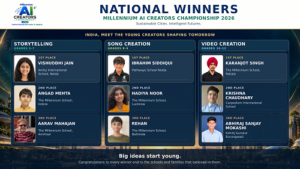
The Millennium Group of Schools Announces Winners of Millennium AI Creators Championship 2026, Celebrating Young India's Responsible AI Creators

The Millennium Group of Schools has announced the winners of the Millennium AI Creators Championship 2026, a national initiative that brought together school students from across India to explore the creative possibilities of Artificial Intelligence while developing responsible, ethical and future-ready approaches to technology.   Winners of Millennium AI Creators Championship 2026 organised by Millennium Group of Schools   Held around the theme ‘Sustainable Cities. Intelligent Futures.’, the championship encouraged students to imagine how AI and human creativity can come together to address real-world challenges and contribute to cleaner, greener, kinder and more inclusive cities. The initiative was open to students from Grades 5 to 12 across India and was organised with Times Now, the leading English news channel from The Times Network, as the Official Broadcast Partner.   The championship featured three age-specific creative challenges: Grades 5–7: Storytelling Challenge Winner:  Vishuddhi Jain Angad Mehta Aarav Mahajan Grades 8–9: Song Creation Challenge Winner:  Ibrahim Siddiqui Hadiya Noor Rehan Grades 10–12: Short Film Challenge Winner:  Karanjot Singh Krishna Chaudhary Abhiraj Sanjay Mokashi   The championship brought together students from across India, with entries evaluated on originality, creativity, storytelling, relevance to the theme, responsible use of AI and overall impact.    Commenting on the conclusion of the championship, Neha Vaz, Head of Events & Strategic Alliances, The Millennium Group of Schools, said, “The response to the Millennium AI Creators Championship has demonstrated the curiosity and creative potential that young learners bring to conversations around Artificial Intelligence. What stood out was the way students used AI not simply to create, but to explore ideas, tell stories and engage with real-world challenges. Through this championship, we wanted to reinforce that responsible AI use begins with human imagination, critical thinking and intent. The winning entries reflect that spirit and serve as an encouraging reminder of what is possible when technology becomes a tool for young minds to express and build their ideas.”   As part of the championship, registered participants also received access to expert-led sessions covering prompt engineering, AI ethics and digital citizenship, helping students understand the responsible use of AI while strengthening critical thinking, creativity and innovation.   The Top 15 National Winners will receive an exclusive, fully sponsored AI Fellowship powered by TechnoKids in association with Knowledge Hub, providing advanced learning and coding opportunities to further develop their AI capabilities and future-ready skills. Winners will also receive robotics kits from E-BOT Plus, a solution designed around Computer Science, Coding, AI and Robotics, with a focus on practical and intuitive learning.   Speaking on the educational significance of the championship, Dr. Priyanka Jain, Head of Academics, The Millennium Group of Schools, said, “The Millennium AI Creators Championship has given students an opportunity to engage with Artificial Intelligence through creativity, inquiry and real-world problem-solving. The quality and diversity of the submissions demonstrate that when learners are given the right guidance, AI can become a powerful medium for expressing ideas and exploring solutions. Our focus has been to help students understand that responsible use of technology is as important as technical capability, and we hope this experience encourages them to continue questioning, creating and learning with purpose.”   The championship forms part of The Millennium Group of Schools’ broader focus on preparing students for a technology-led future while keeping creativity, critical thinking, ethical awareness and human imagination at the centre of learning. By bringing AI into a structured, creative and age-appropriate learning environment, the initiative sought to encourage students to build with AI rather than simply depend on it.   About The Millennium Group of Schools The Millennium Group of Schools is a prominent chain of K-12 schools across India that follows the CBSE curriculum. Known for its holistic, child-centric approach, the institution follows the award-winning, research-backed Millennium Learning System™ (MLS™), developed through 10+ years of action research, to create personalised, experiential learning experiences that nurture curiosity, creativity, conceptual understanding and real-world application, while integrating global learning theories with the Indian education and value system.

The Millennium Group of Schools Announces Winners of Millennium AI Creators Championship 2026, Celebrating Young India's Responsible AI Creators Read More »