kalabhumitalkies.com

October 16, 2026

Best-Selling Used Hatchbacks in India in 2026: Why These Five Still Lead the Market

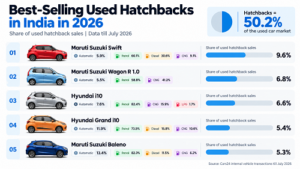
Five hatchbacks alone account for roughly one in every three used hatchbacks sold through one of India’s largest organised resale platforms. The Maruti Suzuki Swift, Wagon R 1.0, Hyundai i10, Hyundai Grand i10 and Maruti Suzuki Baleno together take 33.7% of sales, and the Swift alone accounts for 9.6%, the largest share of any single model.   Best Selling Used Hatchbacks  in India in 2026 Hatchbacks still hold the bulk of India’s used car market, accounting for 50.2% of all used cars sold. That share has been slipping, though, as demand for SUVs keeps rising and more buyers look for extra ground clearance and a commanding road presence. Even so, a hatchback remains the most practical way into car ownership for first-time buyers, small families and city drivers. The same five names keep showing up at the top of used hatchback sales, and each one earns its place for a slightly different reason. These figures are based on data derived from Cars24’s internal vehicle transactions till July 2026, covering the best-selling used hatchbacks in 2026. Within that dataset, Maruti Suzuki’s three models account for 21.7% of used hatchback sales, with Hyundai’s two at 12.0%. Petrol leads on every model, and manual transmissions still dominate across the board, at 86.6% or more on each one. All shares below are a model’s share of used hatchback sales.   Maruti Suzuki Swift The Swift leads the list at 9.6%, well clear of the Wagon R at 6.8%. It looks sporty, drives with some energy and has stayed within reach of young buyers and small families for two decades. That long history matters on the used side too: because so many people want a Swift, resale is rarely a worry, and that confidence is half the reason people buy one. Fuel choice is varied, with petrol at 60.1%, diesel at 30.6% and CNG at 9.1%. Manual variants account for 94.1% of used Swift sales. Maruti Suzuki Wagon R 1.0 The Wagon R 1.0 takes second place at 6.8%, and its fuel mix is the most unusual on the list: 41.2% of used sales are CNG, with the remaining 58.8% petrol. CNG buyers tend to be daily commuters who care about cost per kilometre above all else, and the tall-boy body adds generous headroom and an easy driving position. If you’re looking at a CNG one, check the cylinder’s test date and remember that it eats into boot space. Budget helps too, since older examples often turn up among second hand cars under 2 lakhs, depending on age, kilometres and city. Manual variants make up 94.5% of used Wagon R 1.0 sales. Hyundai i10 The i10 holds 6.6%, a strong showing for a car that’s no longer sold new. Its small size is the draw: it fits tight parking spots, threads through narrow lanes and costs little to maintain, which suits drivers who spend most of their time in dense city traffic. That mix of low upkeep and easy parking is a big part of why older i10s are still bought in such large numbers. Petrol dominates at 82.4%, followed by CNG at 15.9% and LPG at 1.7%. Automatics are rare here, at 7.6% of sales, so 92.4% of buyers chose the manual. Hyundai Grand i10 The Grand i10 sits at 5.4% and often appeals to buyers who like the i10’s footprint but want a roomier, more modern cabin. It’s also the only Hyundai on the list with a diesel option, taken by 15.8% of buyers, while petrol leads at 73.5% and CNG makes up 10.6%. Automatic uptake is higher than on the i10, at 11.9%, which makes sense for buyers stepping up from a first car. Before you commit to either Hyundai, it’s worth reading a used Hyundai i10 buying guide for the checks that matter on older small cars, from service history to clutch feel. Maruti Suzuki Baleno Rounding out the list at 5.3% is the Baleno, the premium pick here. That shows up in transmission choice: 13.4% of buyers go automatic, the highest share of the five. Petrol makes up 82.3% of used Baleno sales, with diesel at 11.5% and CNG at 6.2%. Even so, manual still wins comfortably at 86.6%. What do these five hatchbacks have in common? Looked at together, these five are built around low running costs, easy servicing and resale confidence rather than outright features. Manual transmissions dominate every model on the list, while CNG has carved out a place on every one of them, most visibly on the Wagon R. Hatchbacks may be losing share to SUVs, but none of these five is chasing novelty, and that’s arguably the point: buyers here are backing cars that have already proven themselves over years of real-world use.

Best-Selling Used Hatchbacks in India in 2026: Why These Five Still Lead the Market Read More »
Big Bang Boom Solutions Announces Ambitious Plan to Build a Sovereign Quantum Radar at IEEE MILCOM 2026

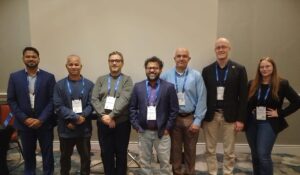
Big Bang Boom Solutions (BBBS), an Indian deep-tech company, organized QuantEW 2026, a workshop on quantum technologies for electronic warfare, at IEEE MILCOM 2026, the IEEE Military Communications Conference, held in the Washington, DC area. At the workshop on 12 October, BBBS Co-founder and Chief Technology Officer Dr. Shivaraman Ramaswamy delivered the opening keynote. In it, he unveiled the company’s plans to build quantum radars and presented a technology assessment and development roadmap.   Dr. Shivaraman Ramaswamy (centre) with attendees at QuantEW 2026, organized by BBBS at IEEE MILCOM 2026   A dedicated quantum-EW forum at IEEE MILCOM IEEE MILCOM is one of the world’s leading conferences on military communications, bringing together researchers, defence agencies, armed forces and industry. Hosting a workshop in its official technical programme is a significant milestone for an Indian company, especially a young startup such as BBBS.   QuantEW 2026 created a forum devoted entirely to the point where quantum technologies and electronic warfare meet. Submitted papers went through peer review, and accepted papers presented at the workshop will be published in the IEEE MILCOM 2026 workshop proceedings and IEEE Xplore.   Dr. Shivaraman Ramaswamy, Co-founder and CTO of BBBS, delivering the opening keynote on quantum radar at QuantEW 2026   Keynote: the case for quantum radar Dr. Shiva’s keynote focused on cutting edge tech around quantum illumination radar. This technique uses entangled signal and idler photons to detect low-observable targets against strong background noise. In such conditions, conventional radar is limited by stealth shaping, thermal noise and spoofing from digital radio frequency memory (DRFM) jammers. Theory shows that quantum illumination can give up to a significant advantage in the detection error exponent over the best classical scheme with the same transmitted energy. That advantage applies in the low-signal, high-noise regime where conventional sensors have the most trouble. The keynote then mapped the gap between this theoretical advantage and what can be built in practice, noting that no field-deployable quantum radar exists today and that cryogenic requirements remain a critical barrier while outlining BBBS’ plans for the same supported by National Quantum Mission.   “Bringing the quantum and electronic warfare communities together at MILCOM was a milestone for BBBS. Quantum Radar is moving from the laboratory toward engineering reality. Our approach is designed to deliver measurable advantage in the contested, noise-dominated environments where it matters most,” said Dr. Shiva.   Roadmap and collaboration BBBS currently places its quantum radar programme at technology readiness level (TRL) 3 and targets TRL 4-5 in about 24 months, with platform-mounted demonstrators and an operational prototype as longer-term goals. The company welcomes collaboration with academia, government laboratories and industry on the open research problems the keynote highlighted.   About QuantEW 2026 QuantEW 2026: Quantum-Enhanced Electronic Warfare and Secure Military Communications was held on Monday, 12 October 2026, as part of IEEE MILCOM 2026, which runs from 12 to 16 October in the Washington, DC area. The workshop was organized by BBBS.   About Big Bang Boom Solutions Big Bang Boom Solutions Private Limited is a Chennai-based deep-tech company, founded in 2018, building defence, homeland security and strategic technologies. Its work spans AI, electronic warfare, autonomous systems and counter-UAS, supported by in-house R&D, engineering and manufacturing and a 20,000 sq. ft. SHAKTI R&D Hub in Chennai. BBBS has won eight iDEX (Innovations for Defence Excellence) projects.

Big Bang Boom Solutions Announces Ambitious Plan to Build a Sovereign Quantum Radar at IEEE MILCOM 2026 Read More »

The Foundery Opens Cohort 2: The Search for India's Next Generation of Entrepreneurs Begins

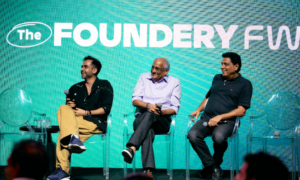
The Foundery has opened applications for Cohort 2 of its 90-day residential venture build, sharpening its search for people who have already demonstrated the ability to build, whether teams, products, categories, communities or businesses and are now ready to create something of their own.   The Foundery, founded by Kishore Biyani, Nikhil Kamath and Ronnie Screwvala, opens applications for Cohort 2   Founded by Kishore Biyani, Nikhil Kamath and Ronnie Screwvala, The Foundery is a venture builder that creates new companies alongside the entrepreneurs who will run them. Cohort 2 will begin on 15 January 2027 at The Foundery Sanctum in Alibaug, bringing a new group of co-founders into an intensive 90-day build environment.   The Foundery does not begin with a pitch competition or require founders to arrive with a fully formed business plan. Co-founders explore opportunities from The Foundery’s Idea Vault and are matched around experience, strengths, conviction and category fit. From there, they build moving from thesis to product, consumer validation and an operating business, with capital, practitioners, operators and shared infrastructure around them from the start.   The model reflects the way companies increasingly get built today. Product, consumer insight, brand, distribution, technology, culture and capital rarely move in a neat sequence; a decision in one area can quickly reshape another. The Foundery is designed to bring those disciplines together around the entrepreneur, rather than leaving founders to assemble them one piece at a time.   Ronnie Screwvala, Co-founder, The Foundery, said, “Capital alone has never built anything that lasts. Founders can lose their first year assembling all the pieces they need to get moving. At The Foundery, those pieces are around them from day one, a head start that helps them move faster, get to market sooner and keep pace with how quickly the world is changing.”   Cohort 1: From Thesis to 18 Companies in 90 Days The first cohort put that model to work. Over 90 days in Alibaug, matched co-founders moved from early theses to 18 companies ready to face investors at The Foundery FWD in Mumbai in July 2026.   The residency brought founders into close proximity with entrepreneurs, investors, operators, creators and cultural voices including Santosh Desai, Rajan Anandan, Aakash Chaudhry, Prasoon Joshi, Garima D. Bahl, Aditya Sehgal, Harsh Mariwala, Diipa Khosla, Rana Daggubati, Jonty Rhodes, Ranveer Singh, Falguni Nayar and Anil Agarwal, among others — bringing perspectives across consumer behaviour, leadership, design, capital, culture, media and company-building into the room.   At The Foundery FWD, the 18 companies generated more than Rs. 550 crore in non-binding expressions of investment interest, with indicated valuations of over Rs. 1,400 crore. For businesses that had begun taking shape only months earlier, it was an early signal of investor conviction in both the companies and the model behind them.   The work has continued well beyond the residency. Cohort 1 companies are now moving full steam toward market, with launches planned through the remainder of 2026 as founders continue building products, teams, distribution and go-to-market plans.   Cohort 2 builds on that foundation, bringing the same concentration of people, capital, expertise and infrastructure around a new set of co-founders — while raising the bar on the kind of entrepreneurial experience and operating muscle entering the room.   Kishore Biyani, Co-founder, The Foundery, said, “India is changing fast, and so is its consumer. After three decades of building consumer businesses, one thing I have learnt is that understanding the Indian consumer cannot be inherited as instinct, it has to be relearned continuously. The next generation of entrepreneurs will need to build for where India is going, not where it has been.”   Nikhil Kamath, Co-founder, The Foundery, said, “Everyone in China says ‘ecosystem, ecosystem, ecosystem.’ Foundery is a small attempt at trying to build that for consumer brands in India. It’s not about how many of the 20 brands per batch succeed or what valuations they achieve, but about the fact that, in 10 years, we would have built the rails and the ‘ecosystem’ by attempting to create 200 Indian brands with the potential to sell globally.”   About The Foundery A venture builder that forges entrepreneurs into co-founders and builds companies with them from the ground up. Every co-founder is matched with an idea from our Idea Vault, aligned with their strengths, experience, and conviction. Over a 90-day venture build at The Foundery Sanctum in Alibaug, they move from thesis to operating company, backed by capital, operators, mentors, and the execution infrastructure needed to build from day zero.

The Foundery Opens Cohort 2: The Search for India's Next Generation of Entrepreneurs Begins Read More »

LIBA's PGDM Sees Rising Interest from Children of Gulf-Based Indians

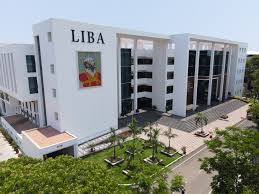
With admissions for the 2027–29 academic year now underway, LIBA is witnessing a notable increase in enquiries and applications from eligible students exploring the Children of Indian Workers in Gulf Countries (CIWG) category. The admission pathway, mandated by the Indian government, enables eligible candidates to apply under the prescribed CIWG provisions, subject to applicable eligibility requirements, selection criteria and documentation.   Loyola Institute of Business Administration (LIBA)   Elaborating on the exclusive opportunity and the gradual increase in numbers, Rev. Dr C. Joe Arun, SJ, Director of LIBA, stated, “We have consistently seen interest from students whose parents are working in the Gulf, and this year the level of enquiries around the CIWG category has been particularly encouraging. For eligible candidates, the category provides an opportunity to explore LIBA’s PGDM programme while availing themselves of the applicable domestic fee structure, subject to the prescribed eligibility and admission criteria.”   LIBA, a Jesuit business school in Chennai, combines industry-oriented management education with its philosophy of “Excellence with Ethics”. Its experiential approach to learning has also attracted students from Indian families based overseas, including the Gulf region. Students admitted under the CIWG category account for approximately 15% of each PGDM batch.   “Over the last few years, we have seen growing interest from students from Gulf-based Indian families. Many of these students have already completed or are pursuing their undergraduate education in India, making a PGDM a natural next step as they prepare for careers in a competitive global business environment,” added Rev. Dr. C. Joe Arun, SJ.   While candidates under the CIWG category are required to meet the prescribed eligibility and admission criteria, including applicable entrance-test requirements, the category provides eligible children of Gulf-based Indians with a distinct pathway to apply to LIBA’s PGDM programme. Final selection remains subject to the institution’s admission process and verification of the required documents.   Admissions for LIBA’s 2027–29 PGDM programme are now open. Eligible students interested in exploring the CIWG category can contact LIBA’s admissions team for information on eligibility, documentation and the application process. Further details are available at LIBA’s official website.   About LIBA A Jesuit business school, LIBA (Loyola Institute of Business Administration) is known for its industry-oriented approach to management education, combining academic rigour with experiential learning. Its Post Graduate Diploma in Management (PGDM) programme is designed to equip aspiring business leaders with the knowledge, skills and ethical perspective needed to navigate a dynamic global business environment. Guided by its philosophy of “Excellence with Ethics”, LIBA continues to nurture responsible leaders who can create meaningful impact across industries.

LIBA's PGDM Sees Rising Interest from Children of Gulf-Based Indians Read More »

Asia's No. 1 Business School Uses AI to Sharpen Judgement in Leaders

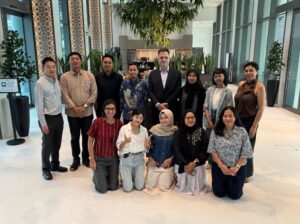
As businesses across Indonesia and Southeast Asia accelerate their use of artificial intelligence (AI), NUS Business School is exploring a different question: as AI gets better at providing answers, how can leaders get better at asking questions?   Dr. Emir Hrnjic, Senior Lecturer in Finance, NUS Business School (fifth from left), at a media engagement with Indonesian media in Singapore For more than a century, case-based learning has put students in the shoes of business leaders by giving information they need to analyse a problem, and then ask them how they would solve it. Now, artificial intelligence (AI) is changing what it means to solve a case. Since January 2026, NUS Business School has been piloting an AI-enabled approach in which students are given an AI-simulated problem where they must determine what information they need, decide whom to ask, evaluate the answers they receive and make a recommendation under uncertainty. The simulation is built on ScholAIstic, a generative AI platform developed by the NUS AI Centre for Educational Technologies (AICET) to support roleplaying and simulation-based learning. Dr Emir Hrnjic, a Senior Lecturer in Finance at NUS Business School, has been working with AICET to adapt and refine these capabilities for management education, developing executive personas around the business case. To date, the tool has now been used by close to 100 MBA and Executive MBA students across Singapore and Jakarta, many of whom are senior executives. Sharpening the human instinct behind good decisions In the pilot, students interview AI-simulated executives, including a Chief Executive Officer, Chief Financial Officer and Chief Product and Technology Officer, each offering a different perspective to the same business situation. Students must navigate these perspectives, assess the information they gather and reach their own conclusions. After each interview, students receive personalised feedback on on their questioning, allowing them to reflect and adapt their approach in subsequent interviews. Dr Hrnjic said: “Students must decide what they need to know, ask the right questions, challenge what they hear and exercise judgement without having the complete picture. The aim is not to replace that human instinct with AI, but to sharpen in by helping students become more discerning about what to ask and trust. That is much closer to how leaders make decisions in the real world.” Early findings suggest that effective use of AI is not about asking more questions but about asking the right ones. Analysis of interview transcripts showed found that stronger interviews had more targeted questions, follow-ups and adaptation as new information emerged, rather than simply working through a prepared list. The findings point to a broader role for generative AI in management education. Rather than using AI primarily to search for information or generate answers, the technology can recreate the real-world scenarios, sharpening executives’ judgement to better navigate uncertainty and competing perspectives they face in real organisations. NUS Business School sees potential for similar AI-simulated tools to be applied to other areas of business education where students need to question stakeholders, negotiate competing interests and make decisions under uncertainty. The ambition is to move beyond the largely static information environment of the traditional case towards a dynamic one where students actively acquire information, pursue emerging lines of inquiry, challenge assumptions and exercise judgement as the problem unfolds. The simulation is one part of NUS Business School’s broader approach to integrating AI into education. The school is exploring how AI can enhance, rather than replace, meaningful learning, thereby helping students develop the judgement, critical thinking and adaptability needed to navigate an increasingly AI-enabled workplace. This becomes increasingly important as AI takes on a greater role in business. Companies across Asia, including Indonesia, are rapidly adopting AI across their operations, making the ability to question and assess AI-generated information an increasingly important leadership skill. For Indonesia, the economic stakes are significant. A 2020 study by Kearney and EDBI projected that AI could contribute USD 366 billion to the country’s GDP by 2030, equivalent to 12 per cent of projected GDP. www.linkedin.com/school/nus-business-school x.com/NUSBizSchool www.facebook.com/NUSBusinessSchool www.instagram.com/nusbizschool/?hl=en   About National University of Singapore (NUS) The National University of Singapore (NUS) is Singapore’s flagship university, which offers a global approach to education, research and entrepreneurship, with a focus on Asian perspectives and expertise. We have 15 colleges, faculties and schools across three campuses in Singapore, with more than 40,000 students from 100 countries enriching our vibrant and diverse campus community. We have also established around 15 NUS Overseas Colleges entrepreneurial hubs around the world. Our multidisciplinary and real-world approach to education, research and entrepreneurship enables us to work closely with industry, governments and academia to address crucial and complex issues relevant to Asia and the world. Researchers in our faculties, research centres of excellence, corporate labs and more than 30 university-level research institutes focus on themes that include energy; environmental and urban sustainability; treatment and prevention of diseases; active ageing; advanced materials; risk management and resilience of financial systems; Asian studies; and Smart Nation capabilities such as artificial intelligence, data science, operations research and cybersecurity. For more information on NUS, please visit nus.edu.sg.   About NUS Business School With 50,000 alumni and 60 global chapters, the National University of Singapore (NUS) Business School is known for providing management thought leadership from an Asian perspective, enabling its students and corporate partners to leverage global knowledge and Asian insights. The school has consistently ranked first in Asia by independent publications and agencies, such as The Financial Times and Quacquarelli Symonds, in recognition of the quality of its programmes, faculty research and graduates. The school is accredited by AACSB International (Association to Advance Collegiate Schools of Business) and EQUIS (European Quality Improvement System), endorsements that the school has met the highest standards for business education. For more information about NUS Business School, please visit bschool.nus.edu.sg. To discover our MBA, MSc or Executive Education courses, visit mscbiz.nus.edu.sg, mba.nus.edu.sg or executive-education.nus.edu.sg

Asia's No. 1 Business School Uses AI to Sharpen Judgement in Leaders Read More »